
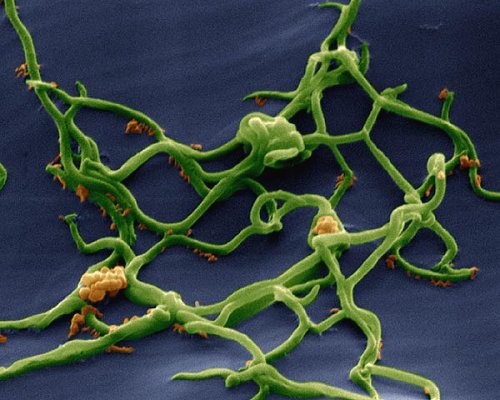
New findings suggest that Borrelia are NOT transmitted only by ticks, but can also be carried by fleas, horseflies AND mosquitoes. (The latter is very rare.)
And… there doesn’t necessarily have to be a circular rash around the “bite”.
When someone has burn-out-like symptoms, it may also be worth checking the blood for Borrelia IgG (CLIA) and IgM (CLIA). The problematic part is this: even if an infection is present, the latency period before titres rise significantly can, in some cases, be around three months. Anyone who wants to do it properly has blood taken twice, three months apart. (**)
This means an infection may remain unnoticed — and untreated — for longer than a quarter of a year.
A suspicion of chronic Lyme disease may be confirmed if you notice several symptoms in yourself — typically more than three at the same time. To carry out this important check-up, please familiarise yourself with the list of complaints below:
Joints, neck and back:
Severe pain that shifts location, appears without any obvious cause, and then disappears on its own.
Swollen lymph nodes
Swollen lymph nodes in the throat and neck, under the armpits, and in the groin. They may occur without pain — or be tender and painful.
Bones:
Pain in the shinbone and heel bone. The pain tends to worsen at night when lying down. Pain at the points where the ribs attach to the breastbone, and along the lower rib arch. The discomfort is often accompanied by a feeling of reduced breathing capacity and a sense of pressure on the chest.
Bannwarth syndrome: severe burning and pulling pain, usually in just one leg or arm, occurring mainly at night.
Head:
Severe, diffuse headaches — or “cap-shaped” or “ring-shaped” headaches.
Hair:
Unexplained, intense pain when combing the hair (so-called “hair-tip catarrh”), as well as diffuse hair loss — mostly in women.
Nails:
Disturbances in nail growth, with brittleness and the formation of ridges.
Skin:
In 40–60% of cases, the so-called erythema migrans (bull’s-eye rash) occurs
More rarely, a lymphocytoma (also called lymphadenosis cutis benigna) occurs: reddened nodules, most often on the earlobes, the scrotum, or around the nipples.
Rare skin changes include so-called “cigarette-paper skin” (seen in acrodermatitis chronica atrophicans).
Burning pain of the skin and/or numbness that appears diffusely across the whole body, or is limited to specific areas of skin.
Eyes:
Functional disturbances of the eyes, such as eye-muscle pain, mild double vision, drooping eyelids, accommodation problems (difficulty focusing), and pupil abnormalities.
Frequent eye inflammation with burning eyes.
Dryness and a foreign-body sensation.
Smell and taste:
Disturbances of the sense of smell and taste
Nose:
Recurring sinus infections that often take a long time to clear, with swelling of the mucous membranes
Muscles:
spontaneous muscle twitching in different parts of the body
sudden, intense shooting pains in the muscles — “like a knife stab” — that keep changing location
Muscle pain and muscle cramps throughout the body without any prior physical strain.
Heart:
recurring palpitations, preferably occurring at night, without any physical exertion.
Urological issues:
Burning pain in the bladder and pain in the testicle with no bacteria detected in the urine
very frequent urination, urinary incontinence
Groin pain with no identifiable organic cause
Exhaustion:
pronounced, long-lasting exhaustion and fatigue without any prior physical exertion.
Psychological symptoms:
Disturbances in serotonin metabolism, with irritability, panic attacks, anxiety, underlying aggressiveness, outbursts of anger, pronounced depressive mood swings and emotional instability.
Severe, long-lasting sleep disturbances, often with nightmares.
Brain:
Irritation of the cranial nerves is common. In the early stage of the illness, the most frequent sign is facial palsy. In the chronic stage, however, several of the twelve cranial nerves can be affected at the same time.
In severe cases: disorientation and major memory loss, similar to Alzheimer’s disease — but also delusions and hallucinations.
Autonomic disturbances:
impaired temperature regulation, often with pronounced chills and feeling very cold.
severe sweating episodes, predominantly at night — but they can also occur during the day in “waves, like during the menopause” in both men and women — or as “flushed, burning cheeks” in the afternoon without fever. Gastrointestinal complaints:
Stomach pain, bloating, a feeling of fullness, irregular bowel movements, loss of appetite.
newly developing lactose intolerance or other food intolerances.
Metabolic changes:
such as hyperacidity, newly elevated cholesterol levels, alcohol intolerance, and thyroid dysfunction (most often an underactive thyroid with TPO autoantibodies — so-called Hashimoto’s thyroiditis).
Especially seen in children:
– Attention difficulties and motor restlessness leading to learning problems (ADHD), irritability, a tendency to argue, and aggressiveness.
-Rarely: severe psychological changes such as psychosis, obsessive symptoms, manic-depressive mood swings, irritability and aggression up to loss of control.
-Cognitive difficulties, such as a decline in short-term memory, problems with concentration, and increased distractibility.
-Attention problems and a reduced ability to learn and process information.
Therapies:
Many long and intensive courses of antibiotics bring only medium-term symptom relief, but they remain the treatment of choice. Most important of all is to treat an infection as early as possible — which is why exclusion diagnostics are essential.
Better to have blood taken one extra time than not enough!!!!
Unfortunately, people are often labelled as “hypochondriacal” or brushed off with remarks like “You just need more rest — go on holiday.”
In practice, relapses can occur again and again, even after antibiotic treatment.
As an alternative — or as follow-up support after antibiotics — some people choose a homeopathic approach, as well as frequency-based methods (bio-resonance). A good Heilpraktiker can genuinely be helpful here.
(**) The same applies to yersinia, although in some regions background exposure titres are clearly established. What long-term consequences a past yersinia infection may have is still being researched.
The same applies to Chlamydia trachomatis.